
Foodtech's False Promises: Why Hype Can't Feed the Bottom Line

Published on: September 24, 2025
Back in the heady days of 2015, there were two startups in the food scene that were all the rage: Soylent and Juicero. Soylent was the all-in-one-only-thing-you-ever-need-to-ingest so you could vibe code twenty four hours a day without wasting your time on more pedestrian tasks like eating. Juicero was the $700 juicer that provided you smoothies galore, until it was found out that the smoothie packets meant for their special widget could be squeezed out by hand into a glass. Juicero went to company heaven, and while Soylent is still around, it has faded into the background.
That got us to thinking. With all that’s happened in the decade since…what’s become of the newest crop of foodtech companies? Have they made significant strides with changing consumer sentiment, or are they flashes in the pan?
We ran an analysis on a sample of food (and tech-related) companies that have gone public since 2017, and their cumulative return since then (either via IPO via SPACs).
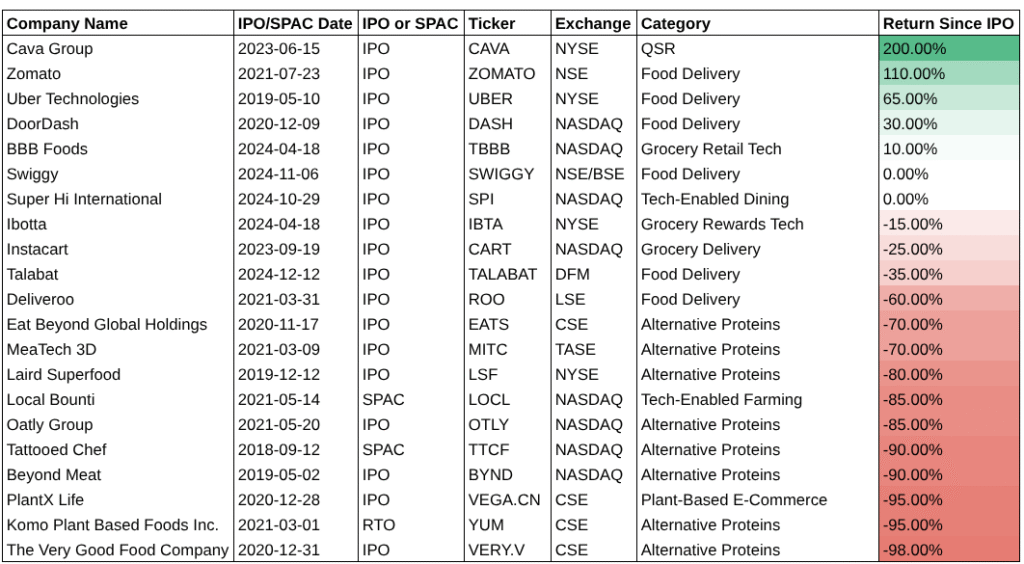
After digging into the data a little more and reviewing the companies, we came away with the following:
This Space is Intensely Fad/Trend Driven
Fully 75% of the companies in the sample had either flat or negative returns since going public. Alternative proteins suffered the largest losses. Whether it’s plant-based, or some intersection of food & tech, the data clearly demonstrates that foodtech builds momentum on hype cycles and buzz words. The pandemic drove a spike in alternative proteins due to supply shortages, and food is one of those categories that works in lock step with social media. This magnified the short term effect. While there was also interest around these products from a sustainability perspective, clearly there hasn’t been enough investor interest to bear that thesis out either.
Based on the evidence, trying to build a scalable, predictable CPG business on media trends (looking at you Dubai Chocolate) will get you neither of those things.
Tech Side Also Underperforms, Except for Delivery Giants
These companies are a mixed bag. The majority of them are either traditional food or retail plays with a layer of technology built into them. And still most don’t outperform.
Perhaps the most stunning data shows that of the ones that do excel in the data set, three belong to the food delivery space. The best performers in this space have nothing to do with food. Go figure. Even within food delivery, it’s a two-horse race between DoorDash and Uber for global supremacy, with Zomato being the strategic play in India.
Unit Economics: Foodtech Doesn’t Scale Like Software
We think that there is a pervasive myth among investors that think foodtech can scale like normal technology. That is simply not the case.
These businesses aren’t recurring revenue models where additional software licenses can be produced at near zero cost. Old school, tangible products still require working capital, trade spend, distribution, logistics, inventory financing, etc. Food brands (at least the best ones) aren’t built overnight. They require years (and sometimes decades) to build loyal customer bases who drive meaningful volumes.
This isn’t just specific to CPG either. Tech-enabled farming was another dud, mainly because those businesses (think AeroFarms and AppHarvest) are capital intensive and slow to mature.
The craze of leveraging the public markets (either via SPACS or IPOs) to accelerate growth is simply an attempt to shortcut the brand-building process by buying your way into it. It is simply too hard, and too unpredictable.
Potentially the bright spot here is Cava, fast casual/QSR Mediterranean chain that tops the list. The company demonstrated positive unit economics from the start, basically meaning they built the business the old fashioned way. Their purchase of Zoe’s Kitchen in 2018 accelerated their growth, but again they were purchasing an asset that had a demonstrated history of operations of profitability. Given that the concept was started in 2010, this success has been a decade and a half in the making. Let’s see if they can keep it up.
We’re involved heavily in helping manufacturers and entrepreneurs managing their supply chains globally, based on the learning from above our advice is simple:
- Focus on what works. Getting a good handle on something that you can execute repeatably and predictably.
- Risk control is key. Anybody can be a cowboy, but it takes a more mature perspective know where the risks may be and how to plan for them.
- Go slowly. Slow is smooth. And smooth is fast.
Rockledge Trading is a specialty distributor & consultant specifically within food and beverage. We work globally and help manage sourcing, logistics, and inventory for distributors, food manufacturers, government agencies, and non-profits.
We also consult on a specialty basis, helping with everything from operations, R&D, market analysis, and management.
If you’re looking for help in any of these areas, you can DM me personally or reach out at RockledgeTrading.com